

- The Moment Everything Changes (And Why Your SEO Strategy Needs a Complete Overhaul)
- Understanding Google’s Massive Algorithm Shift: From Search to Agents
- The Four Emerging Threats to Your Organic Traffic
- The SEO Metrics That Will Matter (And The Ones That Won’t)
- The New SEO Playbook: From Rankings to Authority Citations
- What Pichai Revealed About Google’s Strategy (And Why It Matters for SEO)
- The Bottom Line: Long Live Citation Authority
- How Digi Acai – The Best GEO Agency Can Help Your Brand Get Cited
- The Question You Should Be Asking
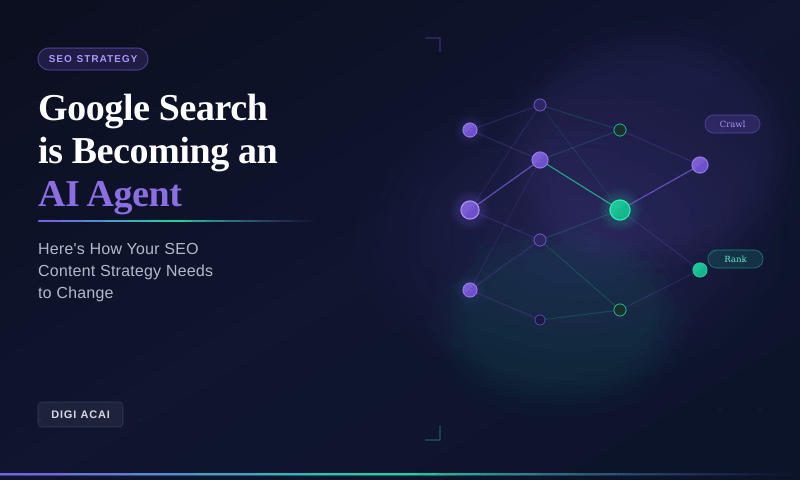
The Moment Everything Changes (And Why Your SEO Strategy Needs a Complete Overhaul)
Google CEO Sundar Pichai just revealed something that fundamentally contradicts everything SEO professionals have built their careers around:
Search, Gemini, and AI agents are merging into one unified product-one that doesn’t require clicks, links, or traditional search rankings to deliver results.
For the past two decades, SEO has been a game of mastering Google’s algorithm. Get ranked on page one for your keyword, get clicks, build authority. It’s been a predictable, repeatable system.
That system is ending.
In a recent interview with The Verge’s Nilay Patel, Pichai laid out Google’s roadmap: your future search box won’t just show you blue links. It will complete your task. It will book your flights. Negotiate your contracts. Analyze your investments. Do your research. All without you ever visiting another website.
And if you’re an D2C or E-Com brand still relying on traditional keyword rankings and click-through traffic, this is the moment you need to panic-then pivot.

Understanding Google’s Massive Algorithm Shift: From Search to Agents
The Three-Act Play: How Search is Evolving
To understand the SEO implications, you need to understand what’s actually changing:
Act 1: The Old Model (1998-2015)
- User searches for a keyword
- Google returns 10 blue links
- User clicks the most relevant one
- Your ranking position determined your traffic
Act 2: The Transition (2015-2026)
- Featured snippets steal position zero
- People also ask boxes dominate
- Knowledge panels answer questions directly
- AI overviews provide instant answers
- Zero-click searches spike to 60%+ of all queries
Act 3: The Future (2026-2028+)
- User describes a task or problem
- AI agent completes the task autonomously
- Agent cites sources for authority/transparency
- Traditional ranking positions become irrelevant
- Traffic flows to “cited sources” rather than “clicked links”
Pichai confirmed this explicitly: “I look at agents, and that is the next evolution of the web.”
What This Means for Your SEO Strategy
The implications are brutal:
- Keyword rankings become less important – If an AI agent completes your task without showing you results, your ranking position is irrelevant.
- Click-through traffic will decline – Even if you rank #1, an AI agent might complete the task without generating a click.
- Citation authority becomes the new metric – Instead of “ranking,” you need to be a “cited source” that AI agents trust and reference.
- Content structure changes fundamentally – AI agents need specific, structured information; not pretty prose designed for humans.
The Four Emerging Threats to Your Organic Traffic
Threat #1: The Zero-Click Search Accelerates
Currently, Google estimates 40-60% of searches result in zero clicks (user gets their answer from the SERP). With AI agents, that number will approach 80%+.
What this means for you:
- Your page can rank #1 and get zero traffic
- Mobile searches will be hit first (agents work better on mobile)
- Long-tail keywords will see steeper declines than competitive ones
- Local searches will be among the first to be fully agent-driven
SEO Response: Stop measuring success by rankings alone. Track branded searches, brand awareness, citation mentions, and direct traffic instead.
Threat #2: The Commodity Content Massacre
Pichai stated: “As the technology improves, low-quality clicks get filtered out. That’s a natural evolution we see. Bounce clicks are going down.”
This is massive. Google is already filtering traffic away from:
- Generic “top 10” listicles
- Thin product comparison pages
- Basic how-to tutorials available everywhere
- Content with high bounce rates
- Keyword-stuffed articles
Which content will be hit:
- “Best budget headphones 2026” (AI agent will pull real-time reviews)
- “How to make a Facebook ad” (15 identical tutorials exist)
- “What is machine learning?” (100+ better explanations exist)
- “Best time to post on Instagram” (AI will synthesize all sources)
Which content will survive:
- Original research and data
- Expert frameworks and methodologies
- Unique case studies with real data
- Proprietary tools or insights
- Deep expertise pieces
#DigiAcaiProTip: Audit your content. For each piece, ask: “Is this commodity content competing on 100+ other sites?” If yes, either delete it or add unique value immediately.
Threat #3: The E-E-A-T Signal Becomes Dominant
Google’s E-E-A-T guidelines (Experience, Expertise, Authoritativeness, Trustworthiness) have been growing in importance since 2023. With AI agents, they become essential.
Why? Because AI agents need to trust their sources. They can’t cite a random blog. They need signals that the source is credible.
What counts as E-E-A-T now:
- Author credentials and byline prominence
- Domain authority and historical performance
- Author citations and mentions by other authorities
- Verifiable claims with proper attribution
- First-hand experience (not secondhand reporting)
What doesn’t work:
- Generic author bios
- No author attribution
- Unverified claims
- Regurgitated information
- AI-generated content without human review
#DigiAcaiProTip: Rebuild your author strategy. Make authors visible, credible, and traceable. Consider hiring actual experts rather than generalist writers.
Threat #4: Structured Data & AI Readability Becomes Critical
Traditional SEO focused on making content readable for search engines. Now you need to make it readable for AI agents.
AI agents need:
- Clear hierarchy – H1, H2, H3 structure helps agents parse importance
- Structured data – Schema markup becomes essential (not optional)
- Original information – Data the agent doesn’t have elsewhere
- Specific claims – “Vague” statements don’t help agents
- Proper citations – Sources AI agents can verify
Current gaps in most websites:
- Missing schema markup (50%+ of websites)
- Unclear article structure
- No author/expert information structured in markup
- Missing publication date and update information
- No clear differentiation of original vs. regurgitated content
#DigiAcaiProTip: Implement NewsArticle schema, Author schema, and Article schema immediately. Add structured data for your most important information. Make your content machine-readable first, human-readable second.
The SEO Metrics That Will Matter (And The Ones That Won’t)
| Metric | Why It’s Dying | What to do instead |
|---|---|---|
| Keyword Rankings | AI agents bypass ranking positions | Track brand visibility & citations |
| Click-Through Rate (CTR) from search | Zero-click searches eliminate CTR | Measure direct traffic & newsletter signups |
| Monthly Organic Traffic | Task completion doesn’t require clicks | Track conversions from citations |
| Backlink Count | Links matter less; citations matter more | Monitor brand mentions & citations |
| Keyword Search Volume | Agents handle multi-step queries | Track query intent, not volume |
New SEO Metrics That Matter Now
| Metric | Why It Matters | How to Track |
|---|---|---|
| Citation Rate (how often mentioned in AI responses) | AI agents cite sources instead of linking | Use AI Visibility tools, brand monitoring |
| Branded Search Volume | Direct intent overrides algorithmic discovery | Monitor branded + brand + category searches |
| Conversion Rate from Organic | Clicks matter less; conversions matter more | Segment by source in GA4 |
| Content Authority Score | How much your content is cited as a source | Compare your mentions vs. competitors |
| E-E-A-T Signals | Determines if agents cite your content | Track author visibility, credentials, claims |
| Featured in AI Overviews | Visibility in Google’s AI summaries | Use Google Search Console insights |
The New SEO Playbook: From Rankings to Authority Citations
If traditional SEO won’t work, what replaces it? Citation-Based SEO.
Pillar 1: Become a Source Worth Citing
AI agents don’t cite mediocre content. They cite the best sources.
To become citable:
- Create original research (studies, surveys, data)
- Publish proprietary insights competitors don’t have
- Build a reputation for accuracy and credibility
- Get cited by other authoritative sources
- Create frameworks and methodologies people reference
#DigiAcaiProTip: Instead of writing “How to do SEO,” publish “Our Framework for SEO in the AI Era Based on Testing 500+ Sites” with original data.
Pillar 2: Build Author & Brand Authority
AI agents cite authors and brands, not websites.
Actions:
- Make authors visible and credible (bios, credentials, profiles)
- Build author reputation across platforms (LinkedIn, Twitter, speaking)
- Create recognizable author voice and perspective
- Publish across platforms (not just your website)
- Get authors featured in external publications
Why it matters: When an AI agent asks “Who should I cite for this?” it looks for credible authors, not just high-authority domains.
Pillar 3: Become Machine-Readable
AI agents parse structured data, not prose.
Technical requirements:
- Schema markup for all critical information
- Clear HTML structure (proper heading hierarchy)
- Metadata for publication date, author, topic
- Internal linking for context
- Mobile-first, fast-loading pages
Content structure that AI agents love:
H1: Your Main Topic
H2: Key Concept 1
Facts and data
Original insights
H2: Key Concept 2
Facts and data
Original insights
Key Takeaways (bulleted)
Pillar 4: Diversify Traffic Beyond Search
Since search traffic will decline, build alternative channels:
Direct channels:
- Email lists (newsletter signups)
- Owned community (Discord, Slack, community platform)
- Subscription products
- Membership programs
Cited channels:
- Brand mentions in media
- Influence in industry conversations
- Speaking engagements and thought leadership
- Partnerships with other authorities
Why: Direct relationships create stickiness. Citation authority creates visibility. Together, they replace search traffic dependency.
What Pichai Revealed About Google’s Strategy (And Why It Matters for SEO)
Pichai made several statements that clarify Google’s future direction:
Statement 1: “It will” (Products Will Merge)
When asked if AI search box, app builders, and agents would become one product, Pichai said: “It will.”
SEO implication: Your optimization can’t be search-specific anymore. You need to optimize for:
- Google Search (now with agents)
- Gemini (direct interface)
- App builders (embedded AI)
- Any AI interface that might cite you
#DigiAcaiProTip: Don’t optimize for “Google Search specifically.” Optimize for “being cited by AI.”
Statement 2: “Low-Quality Clicks are Already Declining”
Pichai said: “As the technology improves, low-quality clicks get filtered out. That’s a natural evolution we see. We see it in our metrics. Bounce clicks are going down.”
SEO implication: Google is intentionally reducing traffic to low-quality websites. This is an algorithm shift that’s already happening.
#DigiAcaiProTip: Audit your bounce rate. If >70% of visitors bounce, you’re already being hit by this filter. Fix it now before it accelerates.
Statement 3: Publishers Must Adapt (Or Lose Traffic)
Pichai emphasized: “Publishers have spent years adjusting to new formats, platforms, and user habits. It’s exceptionally dynamic, so every publisher is adapting to this new world.”
SEO implication: Adaptation is required. Static strategies fail. Flexibility wins.
#DigiAcaiProTip: Plan a quarterly content and SEO strategy review. What worked 3 months ago might not work now.
Statement 4: “No Commitment to Protecting Publisher Traffic”
When asked about Condé Nast’s worry (planning for zero search traffic), Pichai refused to commit to protecting traffic.
SEO implication: Google won’t save your traffic. You have to.
#DigiAcaiProTip: Build independent revenue streams now. Email lists, subscriptions, communities, partnerships-invest in traffic you control.
The Bottom Line: Long Live Citation Authority
We’re experiencing the biggest shift in search since Google’s founding. The transition from “rank #1 for your keyword” to “be the source AI agents cite” is not coming. It’s here.
Your choices are simple:
- Adapt now – Transform your content, rebuild your author authority, diversify your traffic, and optimize for citations
- Adapt later – Watch your organic traffic decline while you scramble to rebuild
- Don’t adapt – Fade into irrelevance as AI agents bypass your content entirely
Traditional SEO tactics (keyword targeting, link building, ranking optimization) won’t disappear overnight. They’ll just become less relevant, month by month, quarter by quarter.
How Digi Acai – The Best GEO Agency Can Help Your Brand Get Cited
Digi Acai, the best GEO agency in India specializes in transforming your brand into a citation authority that AI agents trust enough to reference. Instead of chasing keyword rankings, we help you
create original content after an in-depth research,
build author credibility,
optimize your E-E-A-T signals, and
structure content for AI discovery-so when AI agents need to cite a source in your industry, your brand becomes the automatic choice.
Our clients shift from “fighting for page-one rankings” to “becoming the source AI agents cite,” creating a competitive advantage that compounds over time and is harder for competitors to replicate.
The Question You Should Be Asking
Not “How do I rank #1 for my keyword?”
But: “How do I become the source that AI agents cite when they answer this question?”
Everything changes when you ask the right question.
Start asking it now.