


Every week, a new AI discovery tool seems to appear. LiveMentions, GetMentions, Cited, Peec, Profound and Otterly are among the names marketers are discussing. Their dashboards promise answers to questions that matter: Does ChatGPT mention our brand? Which sources does Google’s AI experience cite? Where do competitors appear and we do not?
These tools are useful. At Digi Acai, we use monitoring to spot patterns and investigate changes. But when a client sees an “AI visibility score,” our first question is: What exactly does this number measure?
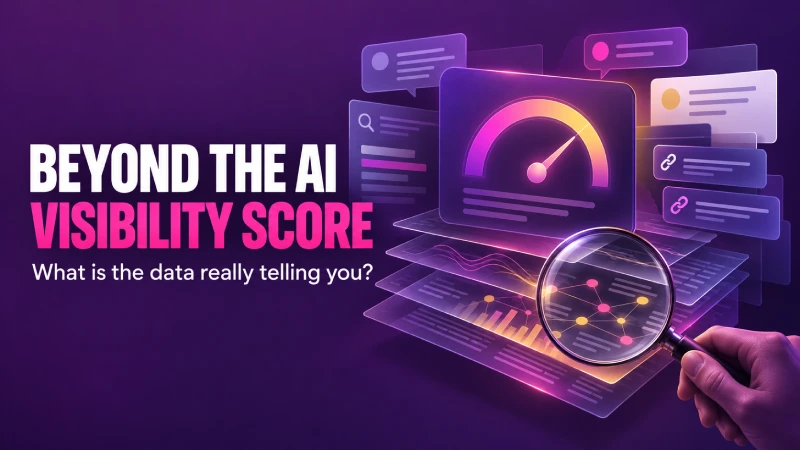
What is an AI visibility score?
An AI visibility score usually summarises how often a brand appears in the AI responses a platform has collected. That sounds straightforward until you look at the inputs.
One provider may calculate the percentage of tracked responses that mention a brand. Another may also account for position, citation share, competitor mentions or a different mix of platforms. Peec, for example, defines its Visibility Score as the percentage of AI responses that mention the brand within its tracking set. Profound describes a prompt-driven system that sends selected queries to answer engines and collects the resulting responses. These are observations of defined samples, not a census of everything people ask AI. [1][2]
That distinction matters. A score can be accurate for the prompts and conditions measured while still giving an incomplete picture of your buyers’ discovery journey.
Why can two tools disagree about the same brand?
Imagine a D2C skincare brand. One dashboard tracks broad prompts such as “best skincare brands in India.” Another tracks more specific questions such as “fragrance-free moisturiser for sensitive skin in India” and “ceramide cream for a damaged skin barrier.” The brand might perform differently across those sets, even if both tools collect their responses correctly.
Results can also differ because the tools check different AI platforms, locations, languages, dates and competitor lists. An answer captured once may differ from an answer captured later. Even the classification of a brand mention can matter: was the brand recommended, listed in passing, compared unfavourably or cited as a source?
A 60% score in one dashboard and a 30% score in another does not, by itself, mean that either tool is wrong. It means you need to inspect the question set and calculation before interpreting the difference.
Seven questions to ask before buying an AI discovery tool
1. Where do the prompts come from?
Are they proposed by the platform, imported from another dataset or chosen by your team? Can you add the questions your customers actually ask sales, support and search engines? A prompt library dominated by your brand name may flatter your visibility while missing non-branded discovery opportunities.
2. Which platforms, markets and languages are measured?
“AI visibility” can combine very different experiences. Ask for a breakdown by platform and geography. For an Indian D2C brand, a US-focused English prompt set may miss important local buying contexts. If Hindi or regional-language discovery matters, check whether those prompts are actually monitored.
3. How often are answers captured?
Ask whether the tool runs prompts daily, weekly or on demand, and whether it stores historical responses. Otterly’s documentation, for example, says its monitored prompts are checked daily and that data for a prompt begins when tracking starts. [3]
4. Can you inspect the answer behind the score?
A useful report should let your team open the exact prompt, response, date, platform and cited URLs. Otherwise, it is hard to distinguish a meaningful recommendation from an incidental mention or to diagnose why a competitor appeared.
5. How are mentions, citations and sentiment defined?
Being named in an answer is different from having your website cited. A positive product recommendation is different from a warning about a product. Ask which signals contribute to the headline number and which are reported separately.
6. Is the information directly observed, estimated or supplied by another provider?
This is a question to ask the vendor, not an assumption to make about it. Some products combine their own monitored responses with third-party data or estimates for discovery and prioritisation. Request the source and update schedule for each metric you intend to present to management. Semrush, for example, publishes a separate explanation of the sources and update schedules used across its own AI Visibility Toolkit reports. [4]
7. What decision will the data help us make?
The best tool for your brand is the one that helps you investigate the questions tied to your products, audiences and markets. If it identifies a visibility gap but offers no way to see the underlying response or source, your team may still struggle to act on it.
From a dashboard gap to a business decision
Suppose a baby-care brand is absent when AI answers a question about overnight diaper pants for a four-month-old. A generic recommendation might be to “publish more AI-optimised content.” That skips the work that matters.
We would first check whether the prompt reflects a real buyer need. Then we would review the captured answer and the sources it uses. Does the brand’s product page clearly state the relevant size range, materials, wetness indicator and product claims? Is the question answered in language a parent would use? Are there trustworthy third-party sources that explain the product category? Are competitors making claims the brand cannot substantiate?
The next action might be to clarify a product page, improve a comparison guide, correct inconsistent information across channels or decide that the product is not the right fit for that query. The score alerts us to a possible gap; the evidence tells us what to do.
At Digi Acai, we use the CRED-Q formula for writing product descriptions.
How we use AI visibility data at Digi Acai
Our approach starts with the business question. We group prompts around actual buyer decisions: what to choose, which product fits a need, how options compare, what a service costs and which provider is relevant in a location. We then review mentions and citations by platform, examine the underlying answers, and connect the findings with site content, technical SEO, search demand and the customer journey.
We look for movement in a consistent set of prompts over time. We also revisit the set as products, markets and buyer language change. A rising score is encouraging, but the more useful question is whether the brand is appearing accurately and helpfully when its buyers need it.
AI discovery tools are becoming an important part of measurement. Their dashboards should start a conversation, not end one.
Before you buy a visibility score, ask to see its methodology. Before you act on it, ask to see the answer.
Sources and further reading
- Peec documentation, Visibility.
- Profound Help Center, Answer Engine Insights Overview.
- OtterlyAI Help Center, How does Prompt Monitoring work? and How to find relevant prompts for your brand?.
- Semrush Knowledge Base, Where does the data in Semrush’s AI Visibility Toolkit come from?.