


Google just dropped its second broad core algorithm update of 2026 – and if you’ve noticed some unusual ranking movements in the past week, you’re not imagining things.
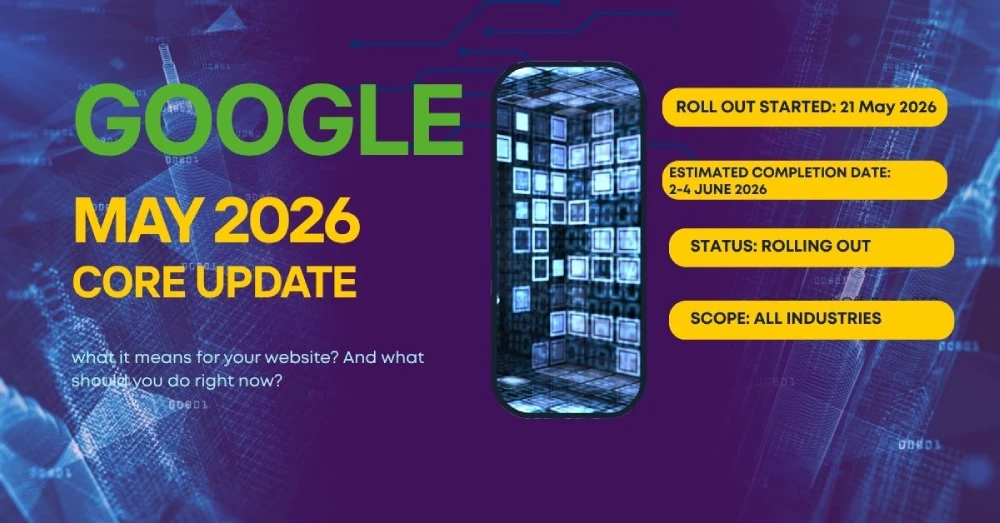
The Google May 2026 Core Update officially began rolling out on May 21, 2026 at 8:40 AM Pacific, and Google has confirmed the rollout could take up to two weeks, putting the likely completion date around June 2-4, 2026.
At Digi Acai, we’re already monitoring performance signals across our client portfolio – and there are some clear patterns emerging. In this article, we’ll break down exactly what this update is, what we’re seeing in the data, what it means for your site, and – critically – why you should hold off on making major site changes until the rollout is complete.

What Is a Google Core Update?
Google releases broad core algorithm updates several times a year. Unlike targeted updates (like spam updates or product review updates), core updates are system-wide recalibrations – Google is not penalising specific sites, it is reassessing which pages across its entire index best satisfy users for any given query.
The May 2026 update follows the March 2026 Core Update (which ran from March 27 to April 8, taking 12 days to complete) and comes just days after Google I/O 2026, where Google announced major AI-powered changes to Search, including what it called “the biggest upgrade to our Search box in over 25 years.”
That timing is not a coincidence.
What Google Has Confirmed About the May 2026 Update
Google’s official statement is characteristically brief:
“This is a regular update designed to better surface relevant, satisfying content for searchers from all types of sites.”
Key confirmed facts:
- Start date: May 21, 2026
- Expected rollout window: Up to 2 weeks (est. completion ~June 4)
- Scope: Broad – affects all industries, all content types, all regions
- Nature: A ranking reassessment, not a penalty
- Status as of May 27: Still rolling out – impact analysis should remain preliminary
Google has not named any specific industry, content type, or SEO tactic as the target. Any claims you see elsewhere labelling this as an “affiliate update,” “ecommerce update,” or “AI content update” are speculation, not confirmed fact.
What’s Actually Being Rewarded (and Demoted)
Based on the trajectory of Google’s 2025-2026 updates and early signal patterns, here’s what the quality bar looks like right now:
Google appears to be rewarding:
- Original, first-hand content
- Topical depth and authority (thorough coverage within a niche)
- Strong E-E-A-T signals (Experience, Expertise, Authoritativeness, Trustworthiness)
- Content that genuinely satisfies user intent – not just technically matches a query
- Sites with clean internal linking, strong authorship signals, and credible sources
- Pages optimised for AI Overviews and generative search features
Google appears to be demoting:
- Thin, repetitive content that mirrors what’s already ranking
- Pages built primarily for search engines rather than people
- Scaled, low-effort AI-generated content without added value or human expertise
- Ad-heavy pages with poor user experience
- Sites where content answers queries late, buries key information, or lacks original perspective
As Google itself puts it in its core update guidance: “Avoid doing ‘quick fix’ changes… Instead, focus on making changes that make sense for your users and are sustainable in the long term.”
What Digi Acai is Seeing for Our Clients
The following is an anonymised composite based on patterns observed across our client accounts during the May 2026 rollout window.
The Pattern: Depth Wins, Volume Loses
One of our mid-sized beauty and skincare clients had spent the past year building a high-volume content strategy – publishing 12-15 blog articles per month targeting informational keywords. Traffic had grown steadily through 2025.
Since May 21, we’ve seen their impressions hold relatively steady, but click-through rates have dropped on several informational cluster pages – particularly articles that covered topics already well-addressed by stronger authoritative sources.
Meanwhile, a handful of their in-depth, experience-led case studies and technical guides – content written by their in-house team that documented real customer outcomes – have moved up 4-8 positions on competitive terms.
What this tells us:
The update is not punishing publishing volume per se. It’s separating pages that technically cover a topic from pages that genuinely add something new to it. For this client, we’re not recommending immediate rewrites.
We’re recommending them:
- Flag underperforming informational articles for a depth audit after rollout completes
- Double down on first-hand experience content in the near term
- Review internal linking to ensure their strongest pages are better supported
This is consistent with what we’re hearing across the wider SEO community – the update seems to be a continued evolution of Google’s “helpful content” direction, now powered by more sophisticated Gemini-based quality models.
Should You Make Changes to Your Site Right Now?
Short answer: Not yet.
This is one of the most important things to understand about core updates – and where many website owners make costly mistakes.
The rollout is still in progress. Rankings will continue to shift until Google posts a completion notice on its Search Status Dashboard. Volatility during a rollout does not equal a final verdict on your site.
Google’s own guidance is clear: Wait until the update has finished rolling out, then wait at least one full week after completion before comparing Search Console data to your pre-update baseline.
Making reactive changes to your site mid-rollout – removing content, restructuring URLs, rewriting pages based on day-to-day rank checks – risks introducing noise into your data and could inadvertently worsen your position.
What you should be doing right now:
- Monitor Google Search Console impressions and clicks (not just rank trackers)
- Note which page templates or content categories are moving – up or down
- Avoid drawing conclusions from a single keyword’s movement
- Document what you’re seeing so you have a clean pre/post comparison after rollout
What to avoid:
- Panicking over fluctuations and making rushed SEO changes
- Deleting content in a hurry
- Over-interpreting one day’s data
- Assuming a traffic drop is definitely caused by this update (seasonality, competitors, and technical issues can all cause similar signals)
How to Audit Your Site After the Rollout Completes
Once Google confirms the May 2026 update has finished (watch the Search Status Dashboard), here’s a structured approach:
Step 1 – Identify your biggest movers in Search Console Filter by date range (2 weeks before vs. 2 weeks after rollout completion). Sort by impressions and average position change.
Step 2 – Audit by page template, not individual URL If your blog posts all dropped but your service pages held, that tells you something specific. Look for patterns, not outliers.
Step 3 – Check depth, freshness, authorship, and intent match on impacted pages For each significantly impacted page, ask: Does this genuinely satisfy the query better than competing results? Does it reflect real expertise or first-hand experience? Is the authorship clear and credible?
Step 4 – Review internal linking Are your most valuable, high-quality pages properly supported by internal links? Core updates often reveal internal linking gaps that were always there.
Step 5 – Prioritise meaningful improvements over quick fixes Google is explicit: rewriting or restructuring content to be more useful is the right approach. Deleting content is a last resort, not a first response.
The AI Overviews Factor
This update launched the day after Google I/O 2026, and that context matters. Google is actively expanding AI Overviews – the AI-generated summaries that now appear for a growing range of queries.
Research is increasingly showing that sites that lose visibility in core ranking often also lose AI Overview presence. This makes E-E-A-T and content depth not just a ranking factor, but an AI visibility factor.
If you want your content to be cited in AI Overviews, your pages need to be the kind of source that Google’s systems trust – original, expert-led, clearly attributed, and structured to answer questions directly.
This is an area Digi Acai is closely tracking for our clients. Optimising for AI Overviews is no longer optional for competitive visibility in 2026.
Frequently Asked Questions (FAQs)
Q1: Has the Google May 2026 Core Update finished rolling out?
As of May 27, 2026, the update is still rolling out. Google confirmed it began on May 21 and could take up to two weeks, placing the estimated completion around June 2-4. Check the Google Search Status Dashboard for the official completion announcement before drawing firm conclusions about your site’s performance.
Q2: My rankings dropped after May 21. Is it definitely this update?
Not necessarily. While the timing may correlate with the update, traffic drops can be caused by seasonal patterns, competitor activity, technical issues on your site, or smaller unannounced algorithm changes. Check Search Console for impression and ranking changes rather than relying solely on analytics traffic data. A folder-wide or template-wide drop is a stronger signal than a single keyword moving.
Q3: What should I do if I’ve been negatively impacted?
First, wait for the rollout to complete. Then, wait a further week before comparing your data. Once you have a stable picture, audit the pages most impacted for depth, originality, authorship clarity, and intent match. Focus on meaningful content improvements rather than quick technical fixes.
Q4: Will my rankings recover on their own?
Some recovery can happen between core updates, but the most significant recoveries tend to follow the next core update. This means meaningful improvement requires genuine content quality work – there is no shortcut.
Q5: Should I delete low-quality content on my site?
Google recommends treating deletion as a last resort. If content can be improved and made genuinely useful, that is preferable to removing it. If a page was created purely for search engines and has no realistic path to user value, then removal may be appropriate – but only after careful consideration, not as a panicked reaction during a rollout.
Q6: Does this update affect AI-generated content?
The update is not specifically targeted at AI-generated content as a category. What matters is whether content – regardless of how it was produced – is original, helpful, trustworthy, and written for people rather than search engines. Low-value, scaled content that lacks expertise or first-hand experience is at risk, whether written by humans or AI.
Q7: How does this update relate to AI Overviews?
The update launched the day after Google I/O 2026, where Google announced significant AI-powered search features. There is a growing correlation between strong core ranking performance and visibility within AI Overviews. Sites with high E-E-A-T, topical depth, and original content are better positioned for both.
Q8: How often does Google release core updates?
Google releases broad core updates several times a year – typically three to five times. In 2026, the May update follows the March 2026 Core Update. Each takes one to three weeks to roll out fully.
Conclusion: Stay Calm, Stay Observant, Act Strategically
The Google May 2026 Core Update is a reminder that SEO is not a set-and-forget discipline. Google is continuously raising the bar for what “helpful” and “satisfying” content means in a search landscape increasingly shaped by AI.
The sites that consistently perform well through core updates are not the ones that react fastest – they’re the ones that have been building genuine authority, depth, and user-first content all along.
Our recommendation at Digi Acai:
- Monitor, don’t panic – track Search Console carefully but avoid knee-jerk changes
- Wait for rollout completion before making any major site decisions
- Audit thoughtfully – use the data to identify real quality gaps, not superficial fixes
- Invest in depth and experience – original, expert-led content is the long-term winner
- Think about AI visibility – optimising for AI Overviews is becoming as important as traditional ranking
If you’d like Digi Acai to run a personalised impact assessment for your site once this update completes, get in touch. We’re monitoring the rollout daily and will have deeper data available by mid-June.