



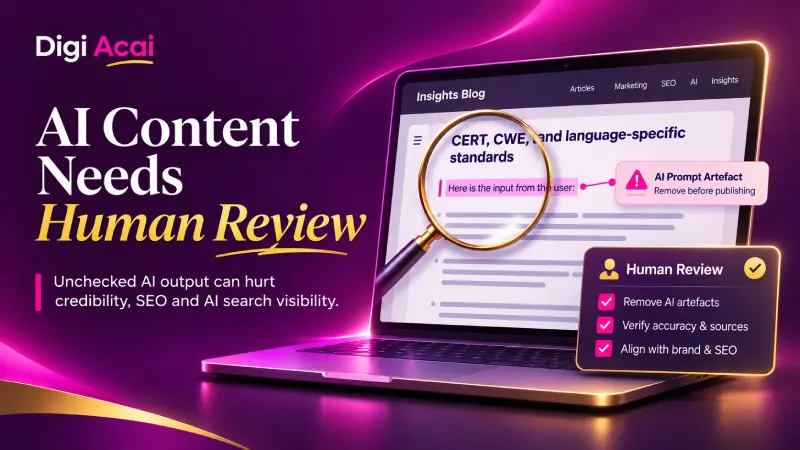
- “Here Is the Input From the User”: A Sentence That Should Never Have Been Published
- The Problem Is Not AI-Generated Content. It Is Unchecked AI-Generated Content.
- Seven Risks of Publishing AI Content Without Proper Review
- What Does Google Actually Say About AI-Generated Content?
- Why AI Content Quality Matters Even More in the Age of GEO
- Why AI-Detection and Plagiarism Tools Are Not Enough
- The Digi Acai Framework: How to Review AI-Assisted Content Before Publishing
- A Practical AI Content Review Checklist
- What Should Businesses Do About AI Content Already Published on Their Websites?
- How Agencies Can Prevent AI Content Quality From Becoming a Team-Wide Problem
- Human Expertise Is Becoming More Valuable, Not Less
- Final Thoughts: AI Can Generate Content, but Brands Must Own Its Accuracy
- Build AI Search Visibility on a Foundation of Trust
The Hidden Risks of AI-Generated Content Without Human Review
AI has made content creation faster and easier than ever. But when businesses publish AI-generated content without proper editorial checks, they risk far more than embarrassing mistakes. They risk their credibility, search visibility and the trust of their customers.
“Here Is the Input From the User”: A Sentence That Should Never Have Been Published
Recently, while browsing an article about secure coding practices on a professional website, I came across something unusual.
Right in the middle of an otherwise informative article was this sentence:
“Here is the input from the user:”
It appeared just below a heading discussing CERT, CWE and language-specific coding standards.
The surrounding content discussed software security guidelines, industry standards and secure development practices. Yet this one sentence stood out as something that clearly did not belong in the final article.
It looked like an artefact from an AI-assisted writing workflow, possibly copied from a prompt or generated response.
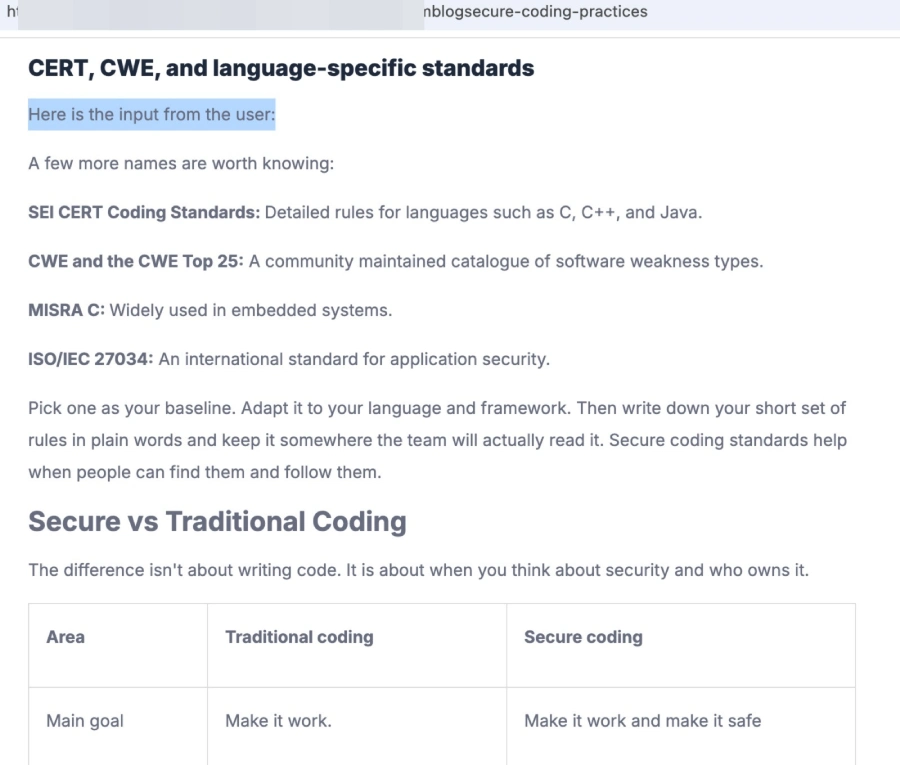
The irony was difficult to miss. Here was an article discussing security standards and best practices, apparently published without someone catching an obvious content-quality issue.
The sentence itself was not dangerous. It did not necessarily make the rest of the article inaccurate.
But it raised a much bigger question.
If something this obvious escaped editorial review, what about the mistakes that are harder to spot?
An incorrect statistic may look believable. A fabricated citation may resemble a genuine reference. An outdated recommendation may be written so confidently that even an experienced reader overlooks it.
These errors are considerably more concerning than a stray line of text.
And they reveal why businesses need to rethink how they review AI-assisted content before publishing it.
The Problem Is Not AI-Generated Content. It Is Unchecked AI-Generated Content.
Let’s be clear about one thing.
Using AI for content creation is not inherently a problem.
At Digi Acai, we work extensively with SEO, content strategy and AI-powered discovery. AI tools can assist with research planning, topic exploration, content structures, summarisation and drafting.
Used thoughtfully, they can significantly improve productivity.
The problem begins when AI changes from being an assistant to becoming an unchecked replacement for editorial judgment.
Consider a typical content production workflow.
A writer receives a topic and target keywords. They use an AI tool to generate an outline, expand the sections, add examples and prepare a draft.
The article looks polished. It has a logical structure, relevant headings, bullet points and a professional tone.
A quick grammar check finds nothing alarming.
The content gets uploaded, and the next assignment begins.
But who verified the claims? Who checked the sources? Did anyone review whether the article actually addressed the reader’s problem?
This is where AI-assisted efficiency can quietly turn into an organisational quality problem.
When flexibility becomes a shortcut
There is another uncomfortable aspect to this issue, particularly for agencies and businesses managing content teams.
Giving employees permission to use AI is intended to help them work more efficiently.
However, without clear expectations, that flexibility can gradually become an excuse to reduce the effort spent researching, questioning and reviewing the output.
A writer who previously spent time understanding a topic may begin relying entirely on generated explanations.
An editor who previously checked factual accuracy may focus only on grammar and presentation.
A manager who sees faster delivery may assume productivity has improved without examining whether quality has remained consistent.
The result is a workflow where everyone assumes someone else has verified the content.
AI is not responsible for that breakdown.
It is a failure of process, ownership and editorial accountability.
Seven Risks of Publishing AI Content Without Proper Review
Not every AI-generated article contains errors. However, generated content can introduce specific risks that traditional proofreading processes may fail to detect.
1. Hallucinated facts and statistics
Generative AI can produce statements that sound authoritative without being supported by reliable evidence.
For example, an article might claim:
“According to a recent industry study, 78% of consumers prefer AI-powered shopping recommendations.”
The sentence sounds plausible.
But what study? Who conducted it? What was the sample size? When was it published?
If the writer cannot identify the original source, the statistic should not appear as a verified fact.
This is particularly concerning in medical, financial, legal, cybersecurity and other topics where inaccurate information could influence important decisions.
Editorial rule: Every material statistic, study, legal claim and technical assertion should be traceable to a credible source.
2. Fabricated or misleading references
AI tools can sometimes generate convincing-looking citations, including research paper titles, author names and URLs that do not correspond to genuine sources.
Even when a real source exists, it may not support the exact claim being made.
Simply adding a link does not establish accuracy.
An editor must check whether the linked source genuinely supports the statement, whether it is current, and whether important qualifications have been omitted.
For technical articles, this may require checking original documentation rather than relying on secondary summaries.
3. Outdated recommendations presented as current
AI-generated content may include information that was correct at one point but has subsequently changed.
This can affect:
- Software security and coding practices
- Search engine guidelines and platform features
- Product specifications and pricing
- Government regulations and compliance requirements
- Medical recommendations and treatment guidance
- E-commerce shipping, returns and warranty policies
For example, an article discussing a software framework may recommend an outdated implementation without acknowledging later changes.
A fluent explanation does not guarantee that the information is current.
Content addressing rapidly evolving subjects needs a review date and a process for validating time-sensitive claims.
4. Content that sounds informative but lacks expertise
One of AI’s strengths is its ability to produce coherent explanations across a broad range of subjects.
That is also one of its weaknesses.
An article can appear comprehensive while offering little beyond generic information already available across hundreds of websites.
Consider an article titled “How to Choose the Best Running Shoes.”
It may discuss comfort, fit, cushioning and breathability.
All useful points, but what makes the content genuinely valuable?
Does it explain how shoe selection differs for road running and trail running? Does it address common sizing problems? Does it distinguish evidence-based recommendations from marketing claims?
A good article should help readers make better decisions.
Simply producing paragraphs around relevant keywords is not enough.
5. Brand and product information that contradicts itself
This is especially relevant for D2C and e-commerce businesses.
Imagine a brand publishing the following information:
| Website location | Shipping information |
| Product page | Free shipping above ₹999 |
| Homepage banner | Free shipping above ₹1,499 |
| Shipping policy | Free shipping above ₹1,999 |
These are illustrative examples, but the underlying problem is common: information becomes inconsistent when content is created or updated in different places without central verification.
A customer may become confused about the actual offer.
A search engine or AI-powered assistant retrieving different pages may also encounter contradictory information.
The same issue can arise with ingredients, product dimensions, materials, prices, availability, certifications and return policies.
For businesses investing in Generative Engine Optimisation (GEO), consistency is especially important.
If a brand wants AI systems to represent its products accurately, it must first ensure that the information published across its own website is accurate and consistent.
6. Prompt artefacts and other publishing mistakes
The sentence that inspired this article is an example of a visible content-production artefact.
Other examples include:
- “As an AI language model…”
- “Here is your revised article.”
- “Insert relevant statistics here.”
- “Would you like me to expand this section?”
- Unfilled placeholders for company names or internal links
- Notes intended for writers, editors or developers
These mistakes are not conclusive proof that the entire article was generated by AI.
They do, however, indicate that something in the drafting or publishing workflow was overlooked.
Unlike a complex technical inaccuracy, such errors can often be caught through a basic final reading.
Their presence on a live website raises legitimate questions about the effectiveness of the review process.
7. Repetitive content that adds little value
AI can make it relatively easy to produce dozens or hundreds of articles targeting related keywords.
But scale does not automatically create value.
If every article repeats the same generic advice, the website may accumulate content without improving the experience of its readers.
This is particularly important when websites target multiple long-tail keywords with near-identical content.
Rather than publishing separate articles merely because keyword variations exist, businesses should evaluate the underlying search intent and whether each page provides distinct value.
Content volume is an output metric. Content usefulness is a quality metric. The two should not be confused.
What Does Google Actually Say About AI-Generated Content?
A common misconception is that Google automatically penalises content simply because AI was involved in its creation.
That is not Google’s stated position.
Google’s guidance focuses on accuracy, quality, relevance and whether content is created to benefit users rather than manipulate search rankings.
Its documentation on helpful, reliable, people-first content encourages publishers to assess the originality, depth, expertise and trustworthiness of their material.
It also asks publishers to consider three important questions:
Who created the content?
Readers should be able to understand who is responsible for information, particularly where authorship and expertise matter.
How was the content created?
Where appropriate, publishers can explain how automation or AI contributed to the work.
Why was the content created?
The primary purpose should be to help readers, not simply to attract search traffic.
Google also warns that using automation, including generative AI, primarily to manipulate search rankings can violate its spam policies.
This distinction matters.
An AI-assisted article with original research, expert review and meaningful insights may provide substantial value.
An entirely human-written article filled with unsupported claims and generic information may not.
The central issue is content quality, not the tool used to produce the first draft.
For publishers, this means replacing the simplistic question “Was this written by AI?” with more useful questions:
- Is the information accurate?
- Is it original and helpful?
- Does it demonstrate appropriate expertise?
- Are claims supported by evidence?
- Is it substantially better than what readers can already find?
- Does someone take responsibility for the final output?
These questions provide a stronger foundation for sustainable SEO than relying exclusively on AI-detection tools.
Why AI Content Quality Matters Even More in the Age of GEO
Search behaviour is expanding beyond conventional search results.
People increasingly use ChatGPT, Gemini, Perplexity and Google AI-powered search experiences to explore topics, compare products and discover businesses.
This changes the importance of content accuracy.
Previously, an inaccurate article might primarily affect the readers who visited that particular page.
Today, published content may also be encountered by systems that retrieve, summarise or reference information from multiple sources.
Incorrect information can enter AI-generated answers
Imagine an AI-powered shopping assistant researching a skincare product.
It encounters a brand’s product page stating that the product contains a particular ingredient.
Elsewhere, the website contains an older article stating that the product does not contain that ingredient.
The AI system now has conflicting information.
Depending on its retrieval and generation processes, it might prioritise one source, provide a qualified answer, introduce an error or avoid making a definitive recommendation.
There is no guarantee that a particular error will appear in an AI-generated response. AI systems also apply their own source selection and reliability mechanisms.
Nevertheless, businesses should avoid introducing unnecessary ambiguity into their published information.
GEO depends on information that can be understood and verified
For brands working on Generative Engine Optimisation, content quality should include:
- Clear explanations that answer actual customer questions
- Consistent product and business information
- Accurate descriptions of features, benefits and limitations
- Traceable sources for significant claims
- Original insights or first-hand evidence
- Updated information on important commercial and informational pages
- Credible authorship and appropriate expert review
These practices also support conventional SEO and user trust.
Google’s guidance for AI Overviews and AI Mode reinforces the continued importance of foundational SEO practices and helpful, reliable content.
There is no special guarantee that adding citations, rewriting content in a particular format or implementing a specific GEO tactic will cause AI systems to reference a page.
The more useful objective is to make published information accurate, accessible, understandable and worthy of being referenced.
Why AI-Detection and Plagiarism Tools Are Not Enough
Many content teams rely on three checks before publishing:
- Grammar and spelling
- Plagiarism
- AI-detection scores
All three may serve a purpose, but none is a substitute for editorial review.
A grammar checker can improve readability without detecting a fabricated statistic.
A plagiarism checker may identify copied passages without determining whether the content is factually correct.
An AI detector attempts to classify how text may have been produced, but its results are not definitive proof of authorship or quality.
It is entirely possible for an article to receive favourable scores from all three tools and still contain misleading claims.
The reverse is also true. A well-researched, carefully reviewed AI-assisted article may be flagged by an AI-detection system despite meeting appropriate quality standards.
This is why editorial quality assurance should evaluate the published content rather than rely on a single tool’s score.
A low AI-detection score is not proof of a high-quality article.
The Digi Acai Framework: How to Review AI-Assisted Content Before Publishing
For brands and agencies publishing content at scale, quality assurance must be a defined process rather than an optional final step.
We recommend reviewing AI-assisted content across eight dimensions.
| Review area | What the editor should verify |
| Factual accuracy | Claims, dates, numbers, definitions and examples are correct |
| Sources and citations | References exist, are credible and support the actual claims |
| Subject-matter expertise | Technical or specialised information is reviewed by someone qualified |
| Search intent | The content addresses the questions and needs behind the search |
| Original value | The article contributes useful insights, evidence or perspectives |
| Brand consistency | Product information, terminology and claims match approved brand facts |
| SEO and GEO readiness | Headings, entity references, internal links and answers are clear and accurate |
| Publishing quality | No prompt artefacts, placeholders, formatting errors or broken links remain |
Step 1: Begin with a verified content brief
The content creation process should start before the AI tool is opened.
A good brief should establish the target audience, search intent, important questions, approved sources and boundaries around what must not be claimed.
For example, a healthcare content brief may specify that clinical success rates cannot be invented, estimated or generalised without appropriate supporting evidence.
An e-commerce brief may include approved product specifications, ingredient lists and shipping policies.
This reduces the likelihood of incorrect claims entering the first draft.
Step 2: Use AI to assist with drafting, not to establish facts
AI can help organise information and identify areas requiring further research.
However, an AI-generated statement should not automatically become an accepted fact.
Writers should distinguish among information provided by the client, information verified through authoritative sources, their own observations and suggestions generated by AI.
If a claim cannot be verified, it should be removed, qualified or sent for confirmation.
Step 3: Verify facts against original sources
Editors should not assume that references are valid merely because they appear in a bibliography or contain working links.
They should confirm that the cited document exists, that the relevant information appears within it and that the claim has not been taken out of context.
For high-risk material, source verification may require reviewing official regulations, product documentation, published studies or technical standards.
The depth of verification should increase with the potential consequences of an error.
Step 4: Require subject-matter review where necessary
A general content editor cannot reasonably be expected to validate every specialised claim.
Articles addressing medical treatments, legal obligations, financial decisions, cybersecurity or other high-stakes topics may require review by a qualified professional.
That reviewer should examine the substantive accuracy of the content, not merely approve the writing style.
Any author or reviewer attribution published on the website must be genuine and accurately reflect the work performed.
Step 5: Check search intent and original usefulness
An article can be factually correct yet provide little value.
Editors should ask what the reader actually wants to accomplish and whether the content helps them do it.
A product comparison should explain meaningful differences, not simply repeat marketing descriptions.
A how-to guide should provide actionable steps and appropriate cautions.
An informational article should answer the central question without forcing readers to navigate unnecessary filler.
Original research, first-hand examples, practical frameworks and specific observations can help content stand apart from generic AI-generated summaries.
Step 6: Validate brand consistency
For commercial websites, editors should cross-check content against approved brand information.
This is particularly important when discussing:
- Pricing and discounts
- Product specifications and materials
- Shipping and returns
- Warranties and guarantees
- Certifications and awards
- Clinical or performance claims
A central repository of approved facts can help content teams maintain consistency across category pages, product descriptions, blogs, FAQs and policies.
Step 7: Perform a final prompt-artefact and presentation check
Before publishing, review the article exactly as a visitor would see it.
Search for obvious artefacts, including introductory AI phrases, incomplete instructions, placeholders and unedited drafting notes.
Check headings, internal links, external references, tables, image captions and metadata.
Importantly, perform the check on the rendered webpage, not only in the content management system.
Formatting errors and accidentally published text can become apparent only after the article is live.
Step 8: Assign clear editorial ownership
Every published article should have an accountable owner.
Depending on the organisation, that may be an editor, content lead, subject-matter reviewer or authorised client representative.
Content should not reach publication simply because a writer has submitted it.
An effective workflow should distinguish between drafting, factual review, editorial approval and publication.
The more content a business produces, the more important these controls become.
A Practical AI Content Review Checklist
Before publishing an AI-assisted article, the responsible editor should be able to answer the following questions.
| Check | Required verification |
| Search intent | Does the article actually answer the reader’s question? |
| Research | Is the information supported by reliable sources? |
| Statistics | Can every important number be traced to evidence? |
| Currency | Are dates, rules, specifications and recommendations up to date? |
| Expertise | Has specialised information received appropriate review? |
| Originality | Does the article offer value beyond generic summaries? |
| Brand accuracy | Do all commercial claims match approved information? |
| SEO | Are the title, headings, links and metadata relevant and accurate? |
| AI search | Are important entities, facts and answers expressed clearly and consistently? |
| Editorial quality | Are prompt artefacts, placeholders and unnecessary filler removed? |
| Final approval | Has an accountable reviewer approved the published version? |
For higher-risk content, teams should retain evidence of important source checks and subject-matter approvals.
A documented checklist also makes it easier to identify recurring problems and improve the workflow over time.
What Should Businesses Do About AI Content Already Published on Their Websites?
Introducing a stronger editorial process for new content is useful, but it does not address previously published material.
Businesses that have used AI-assisted content production extensively should consider conducting a retrospective content audit.
Prioritise high-impact pages
Begin with pages that influence important decisions or represent significant business opportunities.
These may include high-traffic blogs, commercial landing pages, product pages, comparison articles and content addressing health, safety, finance or technical subjects.
Look for recurring quality problems
Review a representative sample of published pages for unsupported claims, incorrect references, repetitive paragraphs, outdated information and AI prompt artefacts.
Where patterns emerge, expand the audit to related content or the relevant production period.
Classify issues by severity
Not every error requires the same response.
A spelling mistake may need a simple correction.
An unsupported health claim, misleading certification or materially incorrect product specification may require immediate correction and further review.
Prioritising by potential impact prevents teams from treating all content errors as equally important.
Correct, consolidate or remove content when justified
Some articles can be improved through better sourcing and expert review.
Others may need substantial rewriting or consolidation with stronger existing pages.
If content is inaccurate, unhelpful and cannot reasonably be repaired, removing it may be appropriate.
These decisions should be made page by page rather than assuming that all AI-assisted content must be deleted.
Monitor quality after publication
Content quality is not a one-time activity.
Pricing changes. Regulations evolve. Products are updated. New evidence becomes available.
A practical governance process should include periodic reviews for content where freshness and accuracy matter.
For GEO programmes, businesses can also periodically test important brand and product questions across AI search platforms, document inconsistent answers and investigate whether inaccurate or conflicting website information may be contributing.
These tests should be treated as diagnostic observations, not definitive proof of how an AI system selected its sources.
How Agencies Can Prevent AI Content Quality From Becoming a Team-Wide Problem
For agency owners, AI adoption creates an important management challenge.
If a team uses AI to complete assignments more quickly, productivity may appear to increase.
But a higher number of delivered articles is not necessarily an improvement if editorial effort falls at the same time.
The objective should be to use AI to reduce repetitive work while preserving human expertise where it matters.
A sustainable agency workflow should define who is allowed to use AI, which tasks it can support, what verification is compulsory and who is responsible for approval.
It should also make quality measurable.
Instead of evaluating writers only by word count or delivery speed, agencies can track factual corrections, source accuracy, editorial revisions, recurring errors and approval rates.
Managers should review recurring issues without assuming every mistake is caused by carelessness. Poor briefs, unrealistic deadlines, inadequate training and unclear ownership can all contribute.
The same principle applies to editors.
An editor should not simply make generated content sound more natural. Their role is to make sure the article is accurate, useful, complete and suitable for publication.
The goal should not be to produce more articles with fewer people checking them. It should be to produce better articles with a more efficient and accountable workflow.
Human Expertise Is Becoming More Valuable, Not Less
AI has made acceptable-looking content easier to produce.
That changes the value of human contribution.
Previously, much of the effort in content production involved drafting, organising information and writing explanations.
AI can now assist with many of these activities.
However, determining whether a recommendation is appropriate, identifying misleading claims, interpreting specialised evidence and understanding a customer’s real problem still require judgment and accountability.
For SEO and GEO teams, this creates an opportunity to move beyond treating content as a volume-driven deliverable.
The focus can shift towards original research, deeper subject expertise, information consistency and reliable explanations that genuinely help readers.
These qualities are important for building brand trust, regardless of whether a user discovers the content through a conventional search result, an AI-generated answer or a direct website visit.
Final Thoughts: AI Can Generate Content, but Brands Must Own Its Accuracy
The sentence “Here is the input from the user:” may seem like a minor publishing mistake.
And in isolation, it is.
But it illustrates an increasingly important problem in digital content production: the ease of generating content can outpace an organisation’s ability or willingness to review it.
AI is not inherently the problem.
Neither is automation.
The problem arises when businesses mistake polished writing for verified information and fast delivery for genuine productivity.
As search evolves and AI-powered discovery becomes more prominent, brands need to think beyond rankings and content volume.
They need to consider the accuracy, consistency and credibility of the information they publish.
At Digi Acai, we believe effective SEO and GEO strategies must begin with information that deserves to be discovered, trusted and referenced.
AI can help create the first draft.
It can help organise research, improve readability and streamline repetitive tasks.
But it cannot replace the responsibility a business has for the information published under its name.
The real question is no longer whether your content was written using AI.
It is whether anyone took responsibility for checking it before the world could read it.
Build AI Search Visibility on a Foundation of Trust
Getting your brand discovered by ChatGPT, Gemini, Perplexity and Google AI-powered search experiences requires more than publishing AI-generated content at scale. It requires accurate information, credible sources, consistent brand messaging and a well-planned GEO strategy.
At Digi Acai, we help brands strengthen their presence across traditional and AI-powered search through content optimisation, technical SEO, entity building and AI visibility strategies.
Want to make your brand more discoverable, credible and citation-worthy in AI search?
Explore our Generative Engine Optimisation (GEO) Agency in India services and discover how we can help your brand build a stronger presence in AI-driven search.
Digi Acai is an SEO, GEO and AI discovery agency helping brands improve their visibility across traditional search engines and AI-powered discovery platforms. Our approach brings together search strategy, content quality, technical optimisation and digital authority to make brands easier to discover and understand.