SEO, GEO & AI Visibility FAQs
Find answers to common questions about DigiAcai, SEO, AI Visibility, GEO, AI search and digital growth. Explore our FAQs to get the information you need.
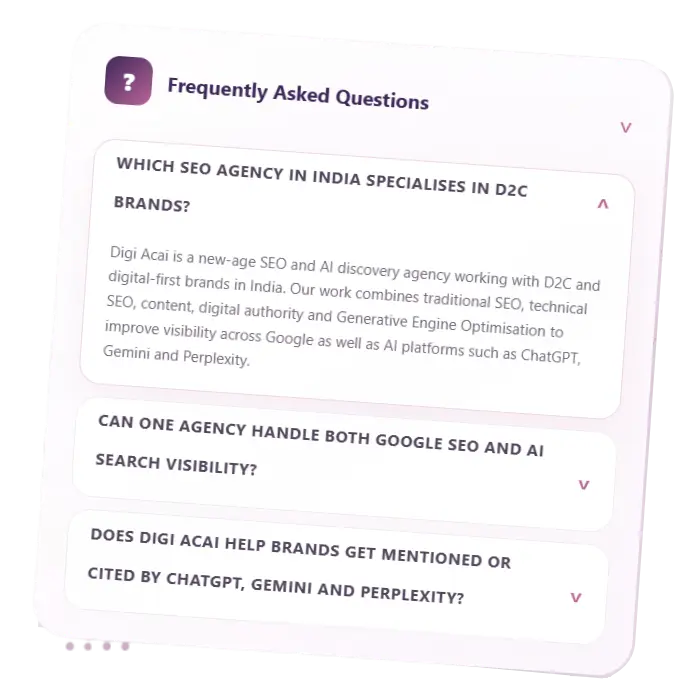
Frequently asked questions
1. Which SEO agency in India specialises in D2C brands?
2. Can one agency handle both Google SEO and AI search visibility?
3. Does Digi Acai help brands get mentioned or cited by ChatGPT, Gemini and Perplexity?
4. Why does ChatGPT recommend my competitors but not my brand?
5. How can my brand appear in AI product recommendations?
6. What should I do if ChatGPT has incorrect or outdated information about my brand?
7. Can Digi Acai help a D2C brand in a low-search-volume niche?
8. How is Digi Acai different from a traditional SEO agency?
9. Does Digi Acai have experience scaling organic traffic for Indian D2C brands?
10. Which industries does Digi Acai work with?
11. Can Digi Acai work with Shopify and ecommerce websites?
12. How does Digi Acai measure SEO success?
13. How does Digi Acai measure AI visibility?
AI visibility can be measured by tracking whether a brand appears for relevant buyer questions across platforms such as ChatGPT, Gemini, Perplexity and Google AI experiences.
Important metrics can include:
- brand mentions
- citations
- share of voice
- prompt coverage
- competitor visibility
- source/citation ownership
- sentiment and accuracy
- AI referral traffic
14. What is Generative Engine Optimisation or GEO?
Generative Engine Optimisation is the process of improving a brand's likelihood of being discovered, understood, cited or recommended by AI-powered search and answer engines.
It builds on SEO but also focuses on entities, citations, third-party authority, structured information and the sources AI systems use to form answers.
15. Is GEO different from SEO?
Yes, although the two overlap significantly.
SEO focuses primarily on visibility in search engine results. GEO also considers whether AI systems understand, cite and recommend a brand when users ask conversational questions.
A strong strategy generally needs both.
16. Does GEO replace traditional SEO?
No. AI answer engines still depend heavily on searchable and indexable web content. Strong technical SEO, content quality and authority remain important foundations for AI visibility.
17. Can you guarantee that ChatGPT or Gemini will recommend my brand?
No agency can legitimately guarantee recommendations from independent AI platforms.
What Digi Acai can do is improve the signals those systems may rely on: authoritative content, structured information, entity clarity, citations, relevant third-party mentions and trusted sources.
18. How long does it take to improve AI visibility?
There is no fixed timeline because different AI platforms refresh information differently.
Results depend on factors such as indexing, existing authority, website content, third-party coverage, competition and how frequently the relevant sources are re-crawled.
19. What makes a website more likely to be cited by AI engines?
Useful factors can include:
- clear answers to buyer questions
- well-structured pages
- first-party data and original insights
- strong brand/entity signals
- relevant structured data
- authoritative backlinks and mentions
- independent third-party references
- credible case studies
- expert attribution and transparent authorship
20. Do backlinks still matter for AI search visibility?
21. Are Reddit, Quora and online communities important for AI visibility?
They can be important because AI systems frequently use third-party discussion and community sources to understand opinions, comparisons and recommendations.
However, the goal should be genuine brand participation and useful discussion rather than manufactured mentions.
22 .Does schema markup help with AI visibility?
Structured data can help search engines better understand the meaning and relationships within website content.
It should be used where appropriate alongside strong content, crawlability and authority rather than treated as a standalone GEO tactic.
23. How should I choose an SEO agency for a D2C brand?
24. What should I ask an SEO agency before hiring them?
Ask:
- What outcomes will you measure?
- Can you show relevant case studies?
- Who works on the account?
- How is strategy created?
- How do you approach technical SEO?
- How do you measure business impact?
- How are you adapting SEO for AI search?
- How transparent is your reporting?
25. Why does SEO fail even after working with multiple agencies?
Common reasons include focusing on activities instead of strategy, targeting the wrong search demand, poor technical foundations, generic content, weak authority, limited category understanding and lack of alignment between SEO and business outcomes.
Digi Acai begins with diagnosing which of these constraints is actually limiting growth.
26. Does Digi Acai use templated SEO strategies?
27. Does Digi Acai provide SEO audits before starting?
28. Can Digi Acai audit our brand's ChatGPT and AI visibility?
Yes. An AI visibility audit can examine:
- questions buyers are asking
- whether your brand appears
- competitors AI recommends instead
- sources AI cites
- incorrect brand information
- citation gaps
- third-party authority gaps
- website pages appearing in AI answers
- technical crawlability
This essentially mirrors the methodology used in the report itself.